
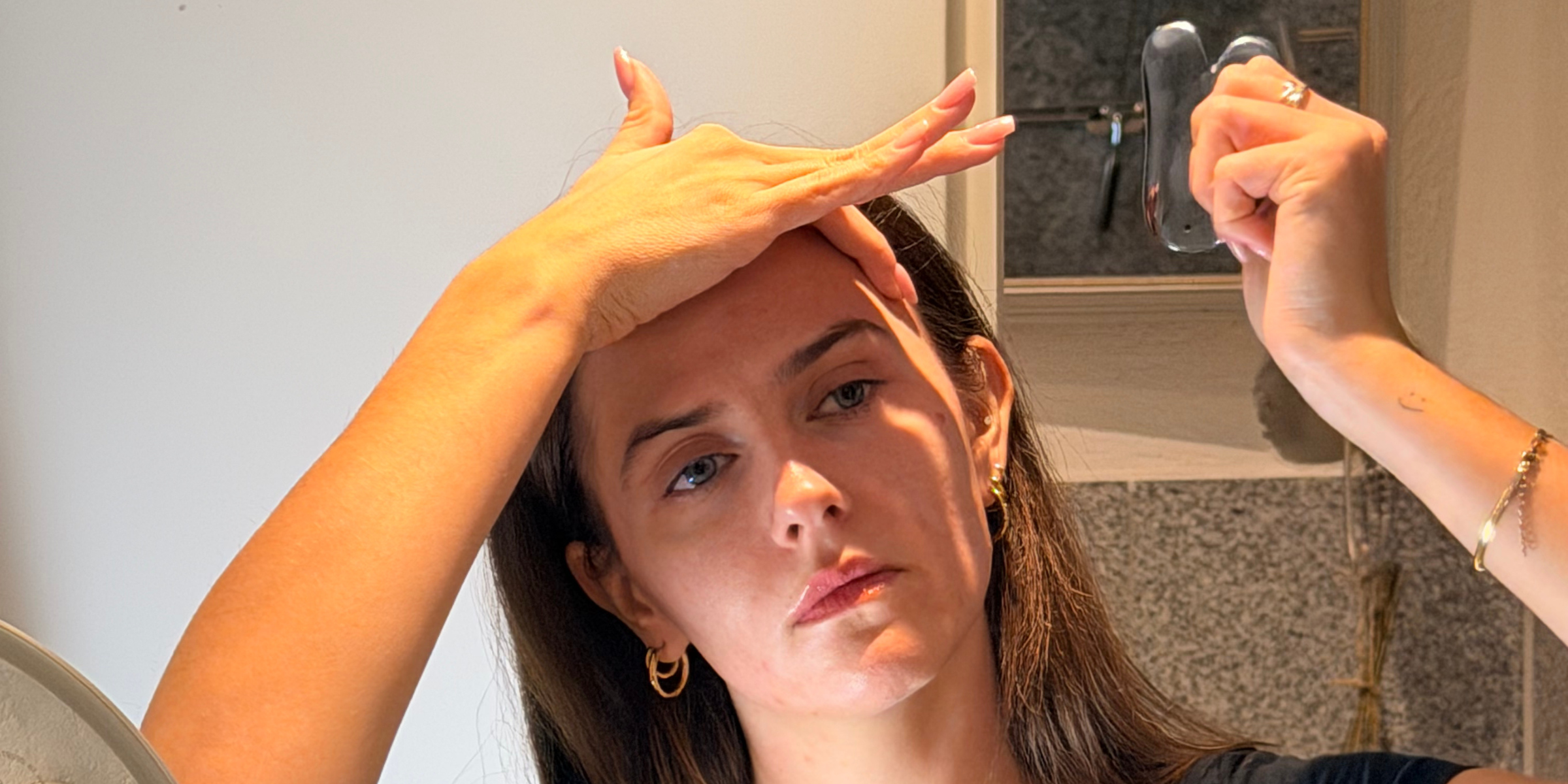
Gua Sha Sequence: this is what most people do wrong
Why the right sequence is more crucial than pressure or technique
Gua Sha is considered a simple tool.
But that's precisely the problem.
Many expect immediate results – and start where they want to see the effect: on the face.
What is often overlooked: Gua Sha is not a muscle tool.
It works with the lymphatic system – and this follows clear physiological rules.
Ignoring these rules doesn't just make the process ineffective; it often makes it counterproductive.
The most common mistake: starting on the face
Studies on manual lymphatic drainage clearly state:
Lymphatic fluid does not flow locally, but always towards prepared drainage areas (Foldi et al., 2012).
If you start directly on the face without opening the drainage points, you'll experience:
-
Congestion instead of drainage
-
Short-term redness without lasting effect
-
Feeling of tension in the tissue
Not because Gua Sha doesn't work –
but because the sequence is wrong.
The physiologically correct Gua Sha sequence
1. Prepare drainage
Before working on the face, the central lymphatic drainage points must be activated:
-
Collarbone region
-
Neck
-
Behind the ears
Studies show that even gentle, superficial movements are enough to stimulate lymphatic flow (Leduc & Leduc, 2000).
Pressure here is not only unnecessary – it can even inhibit the effect.
2. From inside out – with the system
The lymphatic vessels in the face run:
-
From the center outwards
-
Then downwards towards the neck
This direction is not ritualistic knowledge, but anatomically proven (Standring, Gray’s Anatomy).
Working against this flow direction means:
more resistance
less transport
more strain on the tissue
3. Face last
The face is the conclusion, not the start.
If the drainage is prepared, the tissue reacts more sensitively:
-
Less pressure needed
-
Faster relief
-
Visibly clearer contours
This is where the real glow emerges – not through force, but through prepared regulation.
The 3 rules that change everything
Rule 1: More pressure = less effect
Lymphatic vessels lie directly under the skin.
Too much pressure compresses them – and slows down the flow (Olszewski, 2003).
Rule 2: Sequence beats technique
Even perfect strokes remain ineffective,
if the body is not prepared.
Rule 3: Repetition is more crucial than duration
Neurophysiological studies show:
Regular, short stimuli regulate more sustainably than rare, intense applications (Porges, 2011).
Why Gua Sha is more than a beauty tool
When applied correctly, Gua Sha works:
-
Draining
-
Tension-releasing
-
Regulating the autonomic nervous system
Studies on touch and rhythmic stimulation show a measurable activation of the parasympathetic nervous system – the state in which regeneration becomes possible (Field, 2010).
Gua Sha is not a quick fix.
It is a ritual of regulation.
Conclusion
Gua Sha doesn't work through force.
Not through speed.
Not through perfection.
It works through understanding the body.
The right sequence determines whether:
-
Fluid drains or stagnates
-
Tissue relaxes or reacts
-
Glow is visible or only short-term
Glow doesn't come from pressure.
But from system.


Leave a comment
This site is protected by hCaptcha and the hCaptcha Privacy Policy and Terms of Service apply.